10 Best Print-on-Demand T-Shirt Stores for Design Inspiration (2026)
Quick Answer
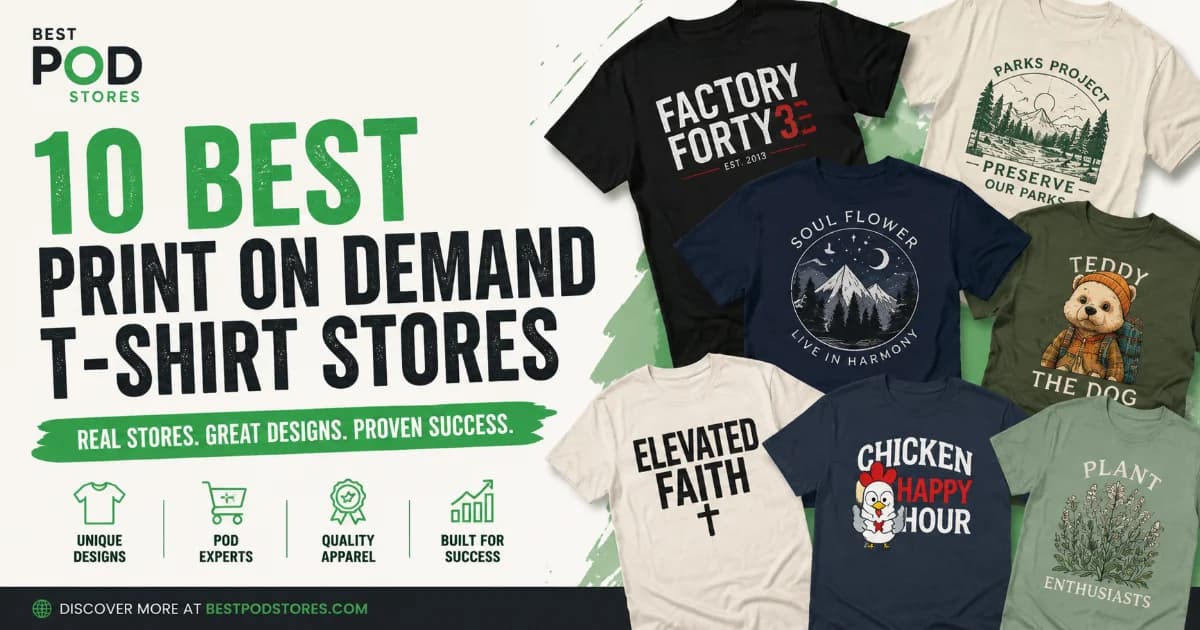
Ten print-on-demand t-shirt stores worth studying in 2026: Factory 43, RESTLESS, Imouri, Got Funny?, Chicken Happy Hour, NIL Store, Kingdom Crown, Plant Enthusiasts, Soul Flower, and Zero Foxtrot.
They are not the ten biggest t-shirt brands. They are ten stores that each solve the hardest problem in the category — why buy this shirt rather than an identical blank with a different graphic — in a different way. Some answer with original artwork, some with an audience that already exists, some with materials and values.
One number frames everything below: five of the ten fulfil in-house, four run on print-on-demand suppliers, and one produces in capped runs of 200. T-shirts are the category where third-party POD genuinely scales, which is not true everywhere — a point we come back to at the end.
How We Picked These Stores
Every store here is catalogued in the Best POD Stores directory, where we record platform, country, fulfilment model, product range and design style. We chose ten from the t-shirt category that between them demonstrate the widest range of viable strategies, rather than ranking them by size or revenue.
They are grouped below by the strategy each one uses, because the grouping is the actual lesson. A flat list of ten stores teaches you nothing; three routes to the same destination teaches you which one fits what you have.
Route One: Original Artwork as the Product
These stores sell design itself. The shirt is a delivery mechanism for artwork you cannot get elsewhere, which is the only durable defence against price comparison.
1. Factory 43 — regional identity as a design system
Country: United States (Seattle) | Platform: Shopify | Fulfilment: In-house
Products: T-shirts, posters, hats | Style: Modern, vintage
Factory 43 is an artist-driven graphic goods brand running both screen printing and direct-to-garment, with designs themed around the Pacific Northwest, national parks, music and sci-fi.
Worth borrowing: the regional series. Place-based design gives you a naturally bounded, infinitely extendable catalogue — every park, city and landmark is another design with a built-in audience who already identify with it. It also sells posters alongside tees from the same artwork, which is the cheapest catalogue expansion available to any design-led store.
2. RESTLESS — scarcity as the entire proposition
Country: Switzerland | Products: T-shirts | Style: Street-art, urban, limited
RESTLESS is a Swiss streetwear label selling street-art-inspired graphic tees in runs capped at 200 pieces per design, with fair-wear production and original designer artwork.
Worth borrowing: the cap itself. "Maximum 200 per design, so you rarely meet a twin" converts a production constraint into the headline benefit, and it justifies a premium without claiming better cotton than anyone else. It is the clearest anti-mainstream positioning on this list, and the hardest to copy with unlimited POD — which is precisely why it works.
3. Imouri — build the IP, then sell it
Country: United States (New York) | Platform: Shopify | Fulfilment: In-house
Products: T-shirts, hoodies, jewelry | Style: Playful, bold
Imouri has run since 2015 as a New York anime streetwear brand built on original characters and Japanese-anime-inspired art, extending across tees, hoodies, jackets, skateboards, jewelry and prints.
Worth borrowing: original-character IP. Most anime merch stores sell licensed properties or skirt the edge of infringement. Imouri built its own characters, which means no licensing cost, no takedown risk, and an asset that appreciates as the audience grows. Slower to start, and the only version of this niche that is genuinely yours.
Route Two: The Audience Comes First, the Shirt Second
These five stores did not start by designing shirts. They started with a community, a following, or a licence, and the merch followed. If you already have an audience anywhere, this is the shortest path in the category.
4. Got Funny? — voice as the differentiator
Country: United States | Platform: Shopify | Fulfilment: Printful
Products: T-shirts, hoodies, crop tops, tank tops, hats, stickers, car magnets
Style: Irreverent, text-driven, absurdist
Got Funny? is an internet-humour apparel brand — self-described as "run by 3 gay raccoons" — with meme and pop-culture designs and standout LGBTQ+ and pride, "college major," and dumb-acronym collections.
Worth borrowing: the brand voice is the moat. The designs are text on a blank and could be reproduced by anyone in minutes; the personality and the collection concepts could not. Note also that this store runs entirely on Printful — proof that a supplier-fulfilled store can build a real brand when the voice is strong enough.
5. Chicken Happy Hour — creator audience to merch
Country: United States | Platform: Shopify | Fulfilment: Printful and Printify
Products: T-shirts, hoodies, hats, tumblers, mugs | Style: Playful, bold
Chicken Happy Hour is the official merch store for a viral social-media flock, selling pun-heavy humour apparel and drinkware.
Worth borrowing: the apparel-plus-drinkware mix, and the use of two suppliers at once. Running Printful and Printify in parallel lets you take the best product and price from each rather than accepting one catalogue's limits — an easy, underused tactic for any POD store past its first few months.
6. NIL Store — licensing as a growth engine
Country: United States | Platform: Shopify | Fulfilment: In-house
Products: T-shirts and jerseys | Style: Modern, bold
NIL Store sells officially licensed college athlete and team merchandise, organised by school and by athlete, with proceeds supporting the athletes themselves.
Worth borrowing: per-school storefronts. One operating model replicated across hundreds of institutions, each with its own built-in fanbase and search demand. If your niche has natural sub-communities — schools, teams, cities, professions, breeds — the same structure applies and it scales far faster than designing individually.
7. Kingdom Crown — content first, merch attached
Country: United States | Platform: Lovable | Fulfilment: Pengine
Products: T-shirts, hoodies, sweatshirts | Style: Modern, clean
Kingdom Crown is primarily a faith community platform — devotionals, prayer, counselling, marriage resources and Christian books — with an apparel line attached rather than a t-shirt store that added content.
Worth borrowing: the ordering. The apparel exists because the community does, so it never has to compete on price or design novelty; it competes on belonging. This is the least glamorous model on the list and probably the most reliable, because the audience arrives for the content and the merch converts a fraction of it at near-zero acquisition cost.
8. Plant Enthusiasts — expertise as the front door
Country: United States | Platform: Shopify | Fulfilment: Pengine
Products: Plants, plant-care products, t-shirts | Style: Minimal, clean
Plant Enthusiasts sells premium plants and plant-care products alongside expert growing guides, with apparel as a deliberate secondary line.
Worth borrowing: content plus commerce, where the care guides do the acquisition and the products do the monetising. Same structural insight as Kingdom Crown from a completely different niche, which is what makes it worth trusting: apparel is a good second product and a hard first one.
Route Three: Materials and Values as the Argument
Two stores compete on what the shirt is and what buying it means, rather than on what is printed on it.
9. Soul Flower — the production method is the pitch
Country: United States | Platform: Shopify | Fulfilment: In-house
Products: T-shirts | Style: Colorful, vintage
Soul Flower is an eco hippie brand selling nature-themed tees hand screen-printed in the USA on organic cotton.
Worth borrowing: every element of the description is a verifiable, specific claim — hand screen-printed, USA, organic cotton. Compare that with the usual "high quality, comfortable fit" copy. Specific claims are checkable, which is exactly why customers believe them and pay more.
10. Zero Foxtrot — identity over aesthetics
Country: United States | Platform: Shopify | Fulfilment: In-house
Products: T-shirts, hoodies, hats | Style: Dark, bold
Zero Foxtrot is a cult military-lifestyle brand honouring service culture across graphic tees, hoodies and hats.
Worth borrowing: the word cult is doing the work. The brand speaks to people who served in language that signals insider status, which means non-members do not get the reference and members feel found. Narrow, deliberately exclusionary positioning outperforms broad appeal in apparel almost every time.
Quick Comparison
| Store | Country | Fulfilment | Route | Mechanic to borrow |
|---|---|---|---|---|
| Factory 43 | US | In-house | Artwork | Regional design series |
| RESTLESS | Switzerland | Small runs | Artwork | 200-piece cap per design |
| Imouri | US | In-house | Artwork | Original-character IP |
| Got Funny? | US | Printful | Audience | Voice as the moat |
| Chicken Happy Hour | US | Printful + Printify | Audience | Two suppliers in parallel |
| NIL Store | US | In-house | Audience | Per-school storefronts |
| Kingdom Crown | US | Pengine | Audience | Community first, merch second |
| Plant Enthusiasts | US | Pengine | Audience | Care guides drive acquisition |
| Soul Flower | US | In-house | Values | Specific, checkable claims |
| Zero Foxtrot | US | In-house | Values | Insider-language positioning |
Why T-Shirts Are Different From Every Other POD Category
Four of these ten stores run on third-party print-on-demand suppliers — Printful, Printify, Pengine — and two of those are among the strongest brands on the list.
That is not true everywhere. When we looked at the best phone case POD stores, every single one had moved to in-house production, because on a phone case the print wraps visible edges and device fit determines returns. Production quality is the product.
A t-shirt is more forgiving. The blank is a known quantity, DTG quality across major suppliers is broadly comparable, and nobody returns a shirt because the print sits two millimetres left. That is why supplier-fulfilled t-shirt brands can compete with in-house ones on equal footing, and why t-shirts remain the right first category for most new POD sellers.
The corollary: because production is not a differentiator in t-shirts, everything else has to be. Design, audience, or values — the three routes above. There is no fourth.
What These Stores Have in Common
- Eight of ten run on Shopify. The exceptions are RESTLESS and Kingdom Crown. Platform choice is not where the differentiation happens.
- None competes on price. Not one positions itself as the cheap option, and several charge a premium justified by scarcity, materials, or cause.
- Most sell more than shirts. Hoodies, hats, posters, stickers, drinkware, jewelry. The tee is the entry product, not the whole catalogue — see our hoodie store examples for the natural second step.
- Every one is legible in a sentence. Military lifestyle. Swiss limited-run street art. Faith community. Viral chicken account. If your store needs a paragraph to explain, it is not positioned yet.
How to Use These Examples
1. Pick your route before you pick your designs
Artwork, audience, or values. Choosing determines everything downstream — pricing, product mix, marketing channel. Most failing POD stores never chose, and end up with generic designs, no audience, and no reason to exist.
2. If you already have an audience anywhere, start there
A newsletter, a following, a local club, a congregation. Route Two stores convert existing attention, which is dramatically cheaper than buying it. Kingdom Crown and Plant Enthusiasts both prove the merch does not have to be the main event.
3. Make your constraint the headline
RESTLESS caps runs at 200 and says so on the tin. Soul Flower prints by hand in the USA. Whatever you cannot do at scale is usually the most interesting thing about you.
4. Narrow further than feels comfortable
"Graphic tees" is not a niche. "Military lifestyle," "anime original characters," "college athlete merch by school" are niches. See our POD niches for beginners guide if you are still choosing.
5. Order samples and check the blank
Bella+Canvas, Gildan and Comfort Colors fit and feel materially different, and your supplier's default is not necessarily the right one for your audience. This is the one production decision that still matters in t-shirts.
FAQ
What are the best print-on-demand t-shirt stores to learn from?
Factory 43, RESTLESS, Imouri, Got Funny?, Chicken Happy Hour, NIL Store, Kingdom Crown, Plant Enthusiasts, Soul Flower, and Zero Foxtrot. Each demonstrates one of three viable strategies — original artwork, an existing audience, or materials and values.
Do the best t-shirt brands use print-on-demand suppliers?
Many do. Four of the ten stores here fulfil through Printful, Printify or Pengine, and two of those are among the strongest brands on the list. Unlike phone cases, where every leading store has moved in-house, t-shirt quality is consistent enough across major suppliers that fulfilment is not a competitive disadvantage.
Are print-on-demand t-shirts still profitable in 2026?
Yes, but not on generic designs. Base costs are low and margins are workable, but the category is saturated with undifferentiated graphics. Profit comes from a specific audience willing to pay above blank-plus-print, which is what all ten of these stores have built.
What makes a print-on-demand t-shirt store stand out?
A single clear answer to "why this shirt and not a cheaper identical one." That answer is original artwork, an audience that already exists, or a values and materials claim that can be verified. Design volume is not an answer.
Which niches work best for print-on-demand t-shirts?
Identity-based niches outperform aesthetic ones, because people buy shirts that say something about who they are. Occupations, faiths, fandoms, service backgrounds, hobbies and local communities all work. Broad style categories like "minimalist" or "vintage" rarely do on their own.
Which t-shirt blank should I use?
Bella+Canvas 3001 is the common choice for retail-feel lifestyle brands, Gildan for volume and price sensitivity, Comfort Colors for heavier vintage and garment-dyed looks. Order samples of each before committing — fit and hand feel differ enough that your audience will notice.
Final Thoughts
The ten stores here have almost nothing in common on the surface: Swiss street art, college athletics, anime characters, devotionals, houseplants, military culture, a viral chicken account.
What they share is that each one can finish the sentence "you buy from us because…" without mentioning price or design volume. That sentence is the actual product. The shirts are just where it gets printed.
Browse the full t-shirt store directory for more examples, filterable by niche, platform, country and fulfilment model.
Keep reading
11 Best Print-on-Demand Niches for Beginners (2026)
Eleven print-on-demand niches for beginners, each backed by real stores from our directory rather than generic advice — with a test for whether a niche is actually worth entering.
What Makes a Print on Demand Store Look Professional?
Learn what makes a print on demand store look professional, from clear branding and focused niches to high-quality mockups, strong product pages, trust signals, mobile-friendly design, and clear shipping policies. Use this guide to make your POD store look more trustworthy, polished, and ready for customers.