11 Best Print-on-Demand Niches for Beginners (2026)
Quick Answer
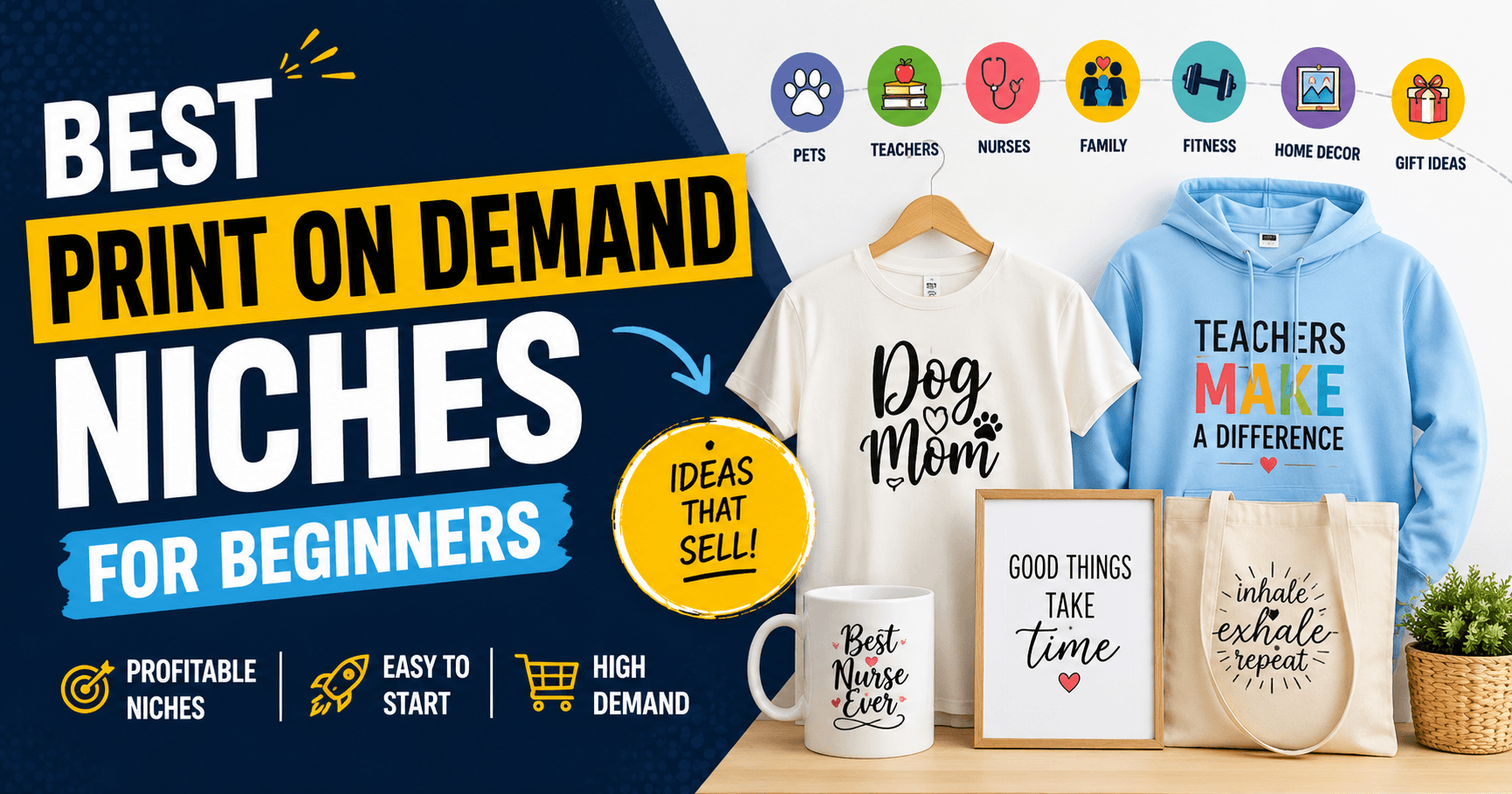
The eleven print-on-demand niches that work best for beginners in 2026 are pet lovers, fitness, home decor and wall art, faith, professions and workplaces, hobbies, personalised gifts, humour, local and regional pride, sports communities, and values-led causes.
What follows is not a list of niche ideas. Every one below is illustrated with real stores from our directory of print-on-demand shops — what they sell, who fulfils their orders, and the specific mechanic that makes each work. Ideas are free; working examples are the useful part.
What Makes a Niche Actually Work
Before the list, the test. A viable POD niche needs all four of these, and most "profitable niche" lists ignore at least two:
- An identity, not a preference. People buy apparel that says something about who they are. "Minimalist design" is a preference. "Nurse," "veteran," "Boston," "corgi owner" are identities. Identities convert; preferences browse.
- A built-in taxonomy. Something that generates variations without new creative direction each time — breeds, schools, cities, professions, sports teams. This is what lets one person build a real catalogue.
- An existing gathering place. A subreddit, a Facebook group, a hashtag, a conference. If the audience never assembles anywhere, your acquisition cost is whatever ads cost.
- Room above the price floor. If the niche's designs are text-on-a-blank that anyone can reproduce, you are competing on price against sellers with lower costs. Personalisation, original illustration, or a values claim keeps you off that floor.
Score any niche idea against those four. Three out of four is workable. Two is a hobby.
The 11 Best POD Niches for Beginners
1. Pet Lovers
Why it works: personalisation is genuinely defensible here — a portrait of someone's specific dog has no competing offer and no price comparison. Breeds give you a ready-made taxonomy of several hundred segments, each with search demand.
Real examples: Lucy & Lola (UK) turns pet photos into embroidered apparel; The Woof Studio (UK) converts photos into illustrated portraits across mugs, prints and phone cases; Arati Devasher (UK) builds entire collections around individual breeds.
Watch out for: generic "dog mom" slogans are the most saturated corner of print-on-demand. Personalisation or a distinct illustration style is the entry price. Full breakdown in our pet niche POD stores guide.
2. Fitness and Lifting
Why it works: gym culture is identity-heavy, communities are highly visible online, and activewear supports all-over printing, which is far harder to copy than a chest graphic.
Real examples: FIERCEPULSE (US) runs 900+ all-over-print leggings and sports bras entirely through Printful, made to order with zero fabric waste — one of the clearest proofs that a pure POD store can operate at real catalogue scale. Kinda Fit Kinda Fat built a community gym brand on inclusive sizing from XS to 6XL. Nine Line Apparel combines veteran-owned positioning with American-made manufacturing.
Watch out for: motivational quote tees are a race to the bottom. The sizing angle and the all-over-print angle are where the defensibility is.
3. Home Decor and Wall Art
Why it works: higher price points than apparel, no sizing to manage, no returns for fit, and buyers purchase in sets rather than singly.
Real examples: Displate built an entire company on one product — metal posters with a tool-free magnet mount — carrying 2.5 million designs from 40,000+ artists plus 200+ official licences. The Print Emporium (Australia) sells gallery-wall sets rather than single prints. Society6 runs the artist-royalty marketplace model with room-based navigation.
Watch out for: shipping costs and damage rates are higher than apparel. Displate's single-product depth is the lesson — one product done exceptionally beats ten done adequately.
4. Faith and Belief
Why it works: strong identity, existing physical communities, and buyers who are not primarily price-driven.
Real example: Kingdom Crown is instructive because the apparel is secondary — it is a faith community platform with devotionals, prayer and counselling, and the merch converts an audience that arrived for the content. Acquisition cost close to zero.
Watch out for: the ordering matters. Community first, merch second, works. Merch first, hoping for community, generally does not.
5. Jobs, Professions and Workplaces
Why it works: occupations are the strongest identities people have, and every profession is its own segment with its own in-jokes. Group and bulk orders are common, which lifts order value considerably.
Real example: Dirty Water Donut Shop (Boston) covers healthcare workers, schools, teams and workplaces from one store, combining ready-to-buy designs with a custom order flow — the single best template on this list for anyone starting with a local network. Zero Foxtrot shows the same logic applied to military service culture, using insider language that non-members do not get.
Watch out for: nurse and teacher designs are heavily competed at the generic end. Specificity — a named hospital, a specialty, a school district — is what separates you.
6. Hobbies and Special Interests
Why it works: hobbyists spend disproportionately on their hobby and gather in dedicated online communities. The narrower the hobby, the less competition and the more devoted the buyer.
Real examples: Imouri (New York) built original anime characters rather than licensing existing ones — no licensing cost, no takedown risk. Plant Enthusiasts pairs expert growing guides with products, letting content do the acquisition. Factory 43 works national parks, music and sci-fi themes into a regional design system.
Watch out for: licensed properties. Fan art of existing IP is the fastest route to a takedown. Build your own characters or work with public-domain and original material.
7. Personalised Gifts
Why it works: personalisation removes price comparison entirely, and gift buyers are markedly less price-sensitive than people buying for themselves. Occasions give you a built-in calendar.
Real examples: Wrappz (UK) makes device and product selection the first step rather than an afterthought. CANVASDISCOUNT runs a 110% lowest-price guarantee with 24-hour production and next-day shipping. Mugify (Australia) frames made-to-order as a lower-waste positive rather than hiding it.
Watch out for: personalisation flows lose customers at every extra step. Upload, preview, buy — and the preview is what converts.
8. Humour and Internet Culture
Why it works: humour is inherently shareable, which means organic reach that other niches have to pay for. Designs are cheap to produce — often text on a blank.
Real examples: Got Funny? runs entirely on Printful and competes purely on voice — the designs are reproducible in minutes, the personality is not. Chicken Happy Hour converts a viral social following into merch, running Printful and Printify in parallel.
Watch out for: this is the lowest barrier to entry on the list, so brand voice is the only real moat. Memes also date fast — build around an enduring sensibility, not a specific joke.
9. Local and Regional Pride
Why it works: place is a strong identity, competition is fragmented by geography, and every city, park and landmark is another design with a built-in audience. Tourists buy too.
Real examples: Factory 43 works the Pacific Northwest and national parks as an extendable series. Dirty Water Donut Shop is built on Boston local pride.
Watch out for: a single city caps your market. The model works when you treat place as a repeatable template, not a one-off.
Browse local and nature stores →
10. Sports and Team Communities
Why it works: fandom is durable, seasonal, and organised into thousands of pre-existing sub-communities — every school, club and league is a segment.
Real example: NIL Store sells officially licensed college athlete merchandise through per-school storefronts, replicating one operating model across hundreds of institutions with proceeds going to the athletes. It is the clearest demonstration on this list of a taxonomy that scales.
Watch out for: professional team logos and names are licensed and aggressively enforced. Amateur, local and college levels are where an independent seller can operate legally.
11. Values and Causes
Why it works: a values claim justifies a premium and turns customers into advocates — provided the claim is specific and verifiable rather than vague.
Real examples: Soul Flower makes checkable claims — hand screen-printed, in the USA, on organic cotton — instead of generic "sustainable" language. Pela Case pairs its compostable material with a $500 screen repair guarantee and published impact numbers.
Watch out for: unverifiable eco claims damage trust faster than making none. Every claim should be something a sceptical customer could check.
Quick Comparison
| Niche | Competition | Best entry angle | Example store |
|---|---|---|---|
| Pet lovers | High | Personalisation and breed collections | Lucy & Lola |
| Fitness | High | All-over print, inclusive sizing | FIERCEPULSE |
| Home decor | Medium | Single-product depth, sets | Displate |
| Faith | Medium | Community first, merch second | Kingdom Crown |
| Professions | Medium | Named workplaces, group orders | Dirty Water Donut Shop |
| Hobbies | Low | Original IP, narrow interest | Imouri |
| Personalised gifts | Medium | Short upload-to-preview flow | Wrappz |
| Humour | Very high | Brand voice as the moat | Got Funny? |
| Local pride | Low | Place as a repeatable template | Factory 43 |
| Sports | Medium | Per-team storefronts | NIL Store |
| Values and causes | Low | Specific, checkable claims | Soul Flower |
Which Products to Start With
Start narrow. One or two products done well beats a catalogue of everything your supplier offers.
- T-shirts — the default first product for good reason: consistent quality across suppliers, universal sizing knowledge, low base cost. See our t-shirt store examples.
- Mugs and drinkware — no sizing, high gift conversion, forgiving print area.
- Art prints — highest margin per unit, no fit returns, buyers purchase in sets.
- Phone cases — strong impulse and gift product, but device coverage and print registration matter more than beginners expect. See our phone case store examples.
- Hoodies and sweatshirts — higher ticket, natural second product once tees sell.
Mistakes That Sink Beginner Stores
Choosing a niche that is really a category
"Graphic tees," "home decor" and "gifts" are categories. "Boston healthcare workers," "corgi owners" and "college baseball" are niches. If you cannot picture one specific customer, it is too broad.
Competing on price
Not one store in our directory positions itself as the cheap option and survives on that. There is always someone with lower base costs.
Publishing designs continuously and randomly
Collections give people a reason to return. A constantly growing, unstructured grid gives them an exit.
Hiding the print-on-demand model
Made-to-order means nothing is produced until it is wanted. Mugify sells that as an environmental benefit. Concealing it wastes a genuine selling point.
Never ordering samples
Blanks differ materially between suppliers, and mockup generators hide colour shift and print placement. This is the cheapest mistake to avoid.
FAQ
What is the easiest print-on-demand niche for beginners?
Personalised pet products and local or regional pride are the two most forgiving. Both have low competition at the specific end, clear taxonomies to build catalogues around, and buyers who are not comparing prices.
What is the most profitable POD niche?
Personalisation-led niches, because a custom product cannot be price-compared. Pet portraits and photo gifts consistently support the highest margins, and wall art has the best margin per unit among non-personalised products.
Which POD niche has the least competition?
Narrow hobbies and specific local communities. The more precisely you can define the customer, the fewer sellers are targeting them — a store for one city's healthcare workers faces almost no direct competition, while "nurse t-shirts" faces thousands.
Should beginners start with a general store or a niche store?
A niche store, without exception. General stores have no reason to exist for the customer and no way to build an audience. Every store in our directory is recognisable in one sentence.
Is print on demand still worth starting in 2026?
Yes, but not with generic designs. Base costs remain low and supplier quality has improved, so the barrier is no longer production — it is differentiation. The stores that work have a specific audience and a clear answer to "why buy from you."
How many niches should I target at once?
One, until it works. Splitting attention across niches is the most common reason beginner stores stall — each niche needs its own audience research, design language and marketing channel.
Final Thoughts
Every niche on this list has someone already succeeding in it, which is the point — proven demand beats an untested gap. What separates the stores above from the thousands that fail is not the niche they chose but how specifically they defined the customer inside it.
Pick one. Define the customer until you can picture them. Then go and look at what the stores here actually do.
Browse the full directory of print-on-demand stores, filterable by niche, product, platform, country and fulfilment model.
Keep reading
What Makes a Print on Demand Store Look Professional?
Learn what makes a print on demand store look professional, from clear branding and focused niches to high-quality mockups, strong product pages, trust signals, mobile-friendly design, and clear shipping policies. Use this guide to make your POD store look more trustworthy, polished, and ready for customers.
10 Best Print-on-Demand T-Shirt Stores for Design Inspiration (2026)
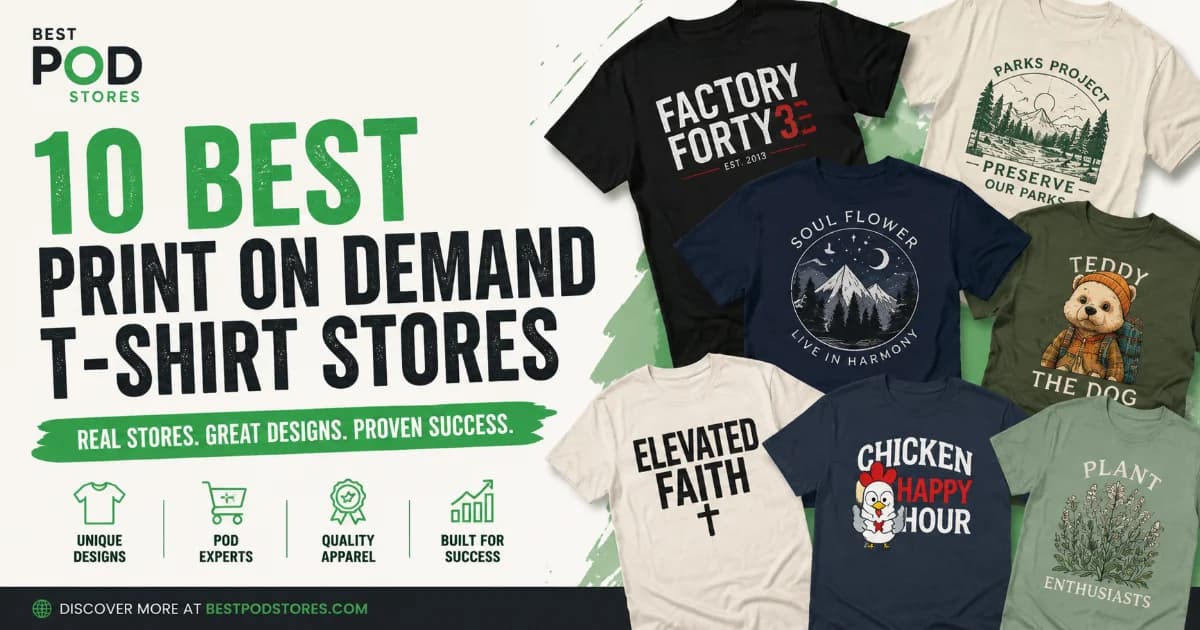
Ten print-on-demand t-shirt stores, grouped by the three routes to standing out: original artwork, an audience that already exists, or materials and values.